
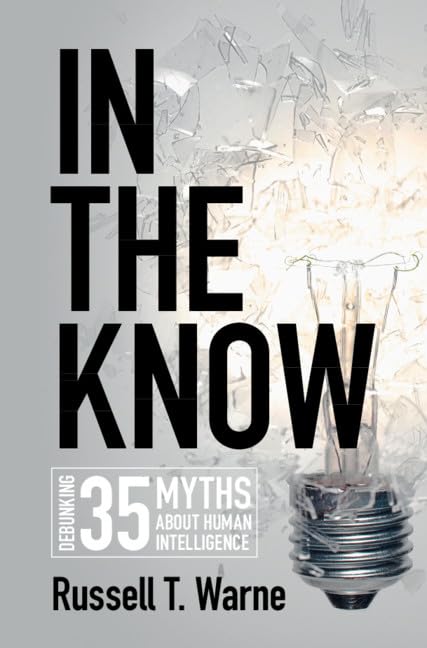
In the know : debunking 35 myths about human intelligence / Russell T. Warne.
Material type: TextPublication details: Cambridge, United Kingdom ; New York, NY : Cambridge University Press, 2020.Description: xviii, 418 p. : illISBN:
 - 9781108493345 (hbk.)
- 1108493343 (hbk.)
- 9781108717816 (pbk.)
- 1108717810 (pbk.)
- BF431 .W37 2020
 Books
Books
| Item type | Home library | Shelving location | Call number | Status | Date due | Barcode | Item holds | |
|---|---|---|---|---|---|---|---|---|
|
Books
|
Punsarn Library | General Stacks | BF431 .W37 2020 (Browse shelf(Opens below)) | Available | PNLIB21060166 |
Browsing Punsarn Library shelves Close shelf browser (Hides shelf browser)
Includes bibliographical references and index.
""Theory about intelligence is more fully developed and more mathematically sophisticated than for almost any other psychological construct. More is known about the underlying cognitive, genetic, and brain processes for intelligence than for any other complex psychological construct" (Detterman, 2014, p. 148). "Intelligence testing may be psychology's greatest single achievement . . ." (Gottfredson, 2009, p. 11). As these quotes show, the scientific study of intelligence is probably the greatest success story in psychology-possibly in all the social sciences. For over 100 years scientists-first psychologists, but later education researchers, sociologists, geneticists, and more-have studied human intelligence. Now, two decades into the 21st century, the results are impressive. The evidence of the importance of intelligence has accumulated to such an extent that informed scientists now cannot deny that intelligence is one of the most important psychological traits in humans (Detterman, 2014; Gottfredson, 1997a). But many people-even psychologists-are not aware of this fact. Unfortunately, inaccurate information and mistruths abound. In media reports the public is told that, "IQ tests are meaningless and too simplistic" (McDermott, 2012). Textbook authors state that, ". . . the question [exists] of whether our tests truly measure intelligence, or whether they merely measure what is called intelligence in our culture" (Gleitman, Gross, & Reisberg, 2011, p. 440). Colleges do not teach about the concept (Burton & Warne, in press), and the scholarly literature contains claims that the concept of intelligence and/or intelligence testing has been debunked (e.g., K. Richardson,2002)".
There are no comments on this title.